
Adding light and outdoor living to a Midcentury Modern rancher

Architects are dreamers, conjuring form and structure where none may exist. But more challenging still is transforming already constructed forms into something new. That’s been a standard exercise for Asheville architect Robert Griffin, whose firm has a long history of converting, enlarging, and reconfiguring existing structures like one currently on the boards, a five-bedroom ranch southeast of downtown Asheville.
Built in 1950 and sitting on a six-and-a-half acre lot, the home was acquired by Griffin’s clients last spring with a general plan to reconfigure and enlarge it to accommodate a considerable family, along with a home office, a sunroom, and a modernized kitchen, among other requests. “I became interested in the project after a call from the clients and a site visit to determine where additions would be feasible,” Griffin explains. “The house is a granite-stone-veneer rancher with a basement on a well-preserved tract of land with beautifully formed, mature oak trees surrounded by dense development.”
The current interior reflects a mid-twentieth-century design aesthetic, with dark pine paneling and low ceilings in the main living areas, a kitchen with minimal counter space and, outside, a detached carport. A lower-level garage with space for five cars was added to the home at some point, but otherwise the house is in close to its original, and well-maintained, condition.
“We’re planning on adding an addition on top of the garage which will enlarge the main level and create [another] bedroom,” Griffin says. His clients have also been exploring converting one of the bedrooms adjacent to the kitchen into a formal dining room, with a break-through wall between them; a deck incorporating an existing stone patio and wrapping around the entire rear width of the house, with access from the primary suite; and raised ceilings throughout the house, among other ideas being discussed. As many as three additions would be integrated with the original home’s footprint.
Elsewhere on the property, guest cottages are under consideration in company with a workshop for carpentry and other crafts, a greenhouse, flower garden, and even a chicken coop. The existing stone and wood siding of the home’s exterior may also be redesigned, along with new window treatments and placements. Initial drawings suggest the incorporation of cedar posts and trim and a windowed enclosed stairway connecting the new living space over the garage to the main body of the house.
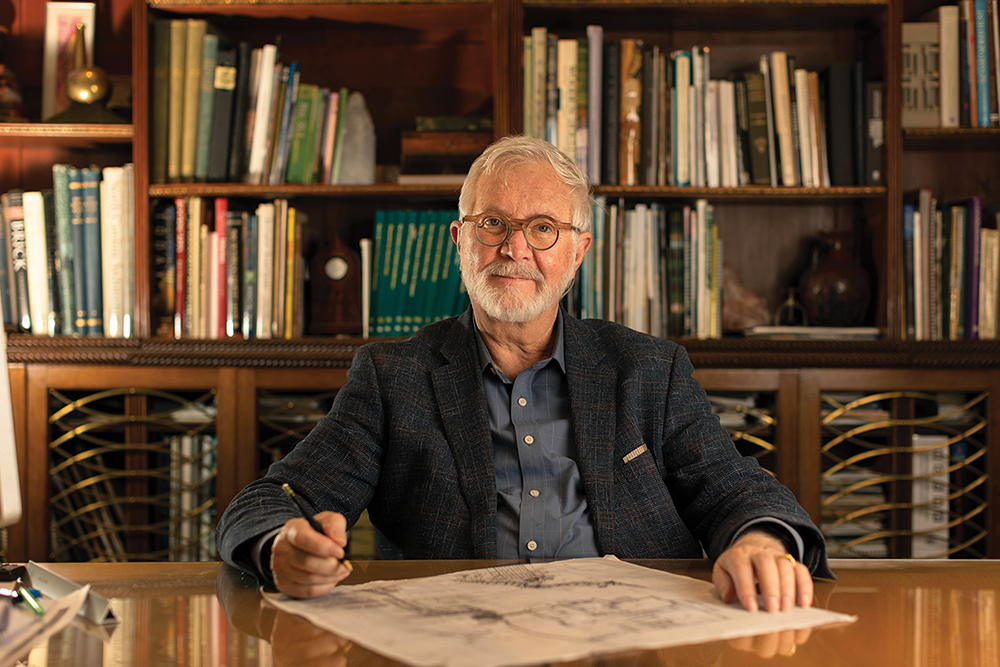
Architect Robert Griffin has been preserving local structures for 40 years.
Portrait by Colby Rabon
Griffin and his team will encounter multiple challenges in the reimagining of the property. “We want to protect existing trees and salvage some of the granite veneer,” he notes, “while maintaining light to the original rooms after adding additions to three sides of the house.” The goal of connecting new phases to an existing structure is “always to protect the original and at the same time integrate the additions … [by way of] a cohesive design.”
Fortunately, Griffin says, the client is farsighted enough to be willing to accommodate the upheavals and temporary discomforts of such an extensive reworking of the property.
The firm is no stranger to such re-imaginings. As well as designing new buildings in a variety of traditional styles and genres, from Arts and Crafts to French Château to Colonial American, renovation of existing gems has long been a key component of the practice. Since founding the firm in 1979, Griffin has served as a key player in the preservation and rebirth of some of Asheville’s most treasured landmarks. The firm was integral to the renovation of the Grove Arcade and in the earliest restoration of Biltmore Village and its Cathedral of All Souls.
During the past 40 years, Griffin Architects has gained a reputation for tasteful and well-integrated additions or complete makeovers for private homes, involving both exterior and interior design. A walk-in closet turns into a library; a sun porch becomes a stone-accented dining room; a plain white stucco façade is transformed with warm Georgian brick.
“We don’t accept commissions based on size,” Griffin says. “Our range of additions has been from 50 to 10,000 square feet, and we have the ability to work in a variety of architectural vocabularies. It’s that diversity we enjoy. We let the client, the site, and the program determine the design organically. We think of ourselves as gardeners tending a germinating seed.”
Griffin Architects P.A., One Village Lane Ste. 1, Asheville, 828-274-5979, GriffinArchitectsPA.com.