
The Black Mountain College story as told by its Midcentury buildings
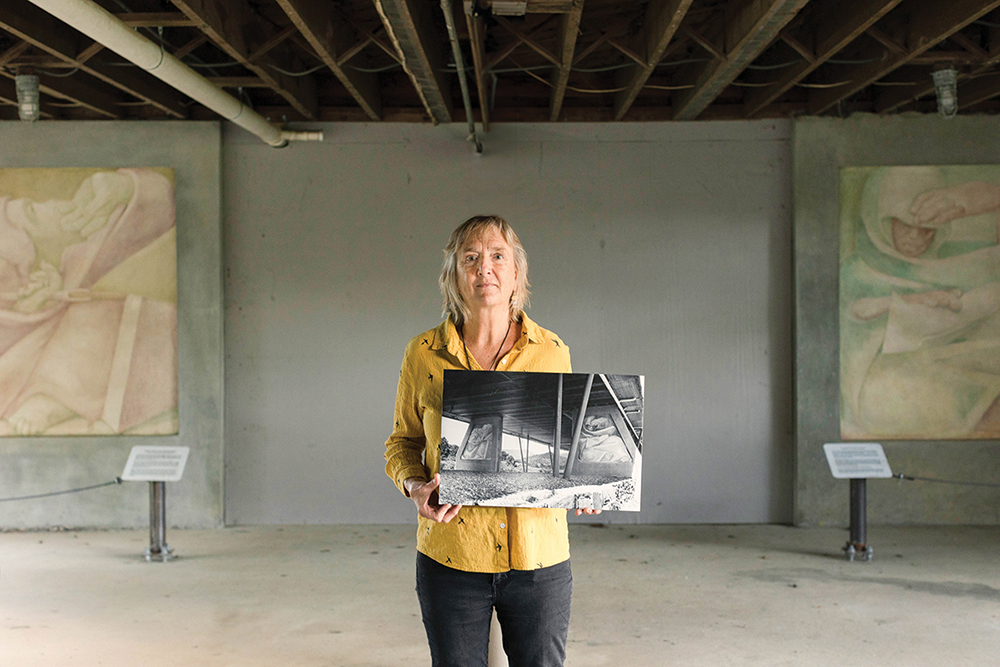
Photo by Colby Rabon
After the summer-long fun at Camp Rockmont, and after the global-culture arts festival LEAF closes out its radiant stint in fall, the 600-acre tract surrounding Lake Eden goes rather quiet.
This idyllic spot in Black Mountain supports both the heritage boys’ camp and the celebrated four-day event in October (Lake Eden Arts Festival turned 30 in 2025). But during the off season, late fall to early spring, visitors can explore the manmade landmarks on these famously scenic grounds.
Structures like the North Lodge and the Studies Building are not just everyday buildings — they’re the original remnants of radical Black Mountain College, an influential and determinedly experimental liberal-arts school that operated from 1933-1957, attracting such innovators as architect Buckminster Fuller (inventor of the geodesic dome), painters Willem de Kooning and Robert Rauschenberg, influential arts educators Josef and Anni Albers, and poets Robert Creeley and Charles Olson, among others.
Campus walking tours are led by Alice Sebrell, the director of preservation at Black Mountain College Museum + Arts Center in downtown Asheville. Sebrell uses key centerpieces to tell the narrative of Black Mountain College, a story as multilayered as the progressive projects that issued from its walls.
The Studies Building was the major construction project at the college. It housed individual work rooms for each student, and the original design was drawn up by visiting lecturer Walter Gropius and his partner. Gropius was the founder of the German Bauhaus arts school — which pioneered the modern fusion of fine art and design with an emphasis on no-frills craftsmanship. However, his Studies Building concept was too large and expensive, so fellow instructor A. Lawrence Kocher — an American innovator of modern architecture — came up with an alternate design.

Photo by Colby Rabon
Beginning in 1940, faculty and students of Black Mountain College constructed the building themselves in about 18 months, using timber and stone they harvested from the property. The Studies Building, when completed, was a long, streamlined, boxy edifice with horizontally continuous “ribbon” windows.
As such, it is believed to be the first example of International Style architecture in the United States.
And while Gropius did not oversee the final project, its process and vernacular reflects one of the German architect’s most well-known quotes: “We want to create the purely organic building, boldly emanating its inner laws, free of untruths or ornamentation.”
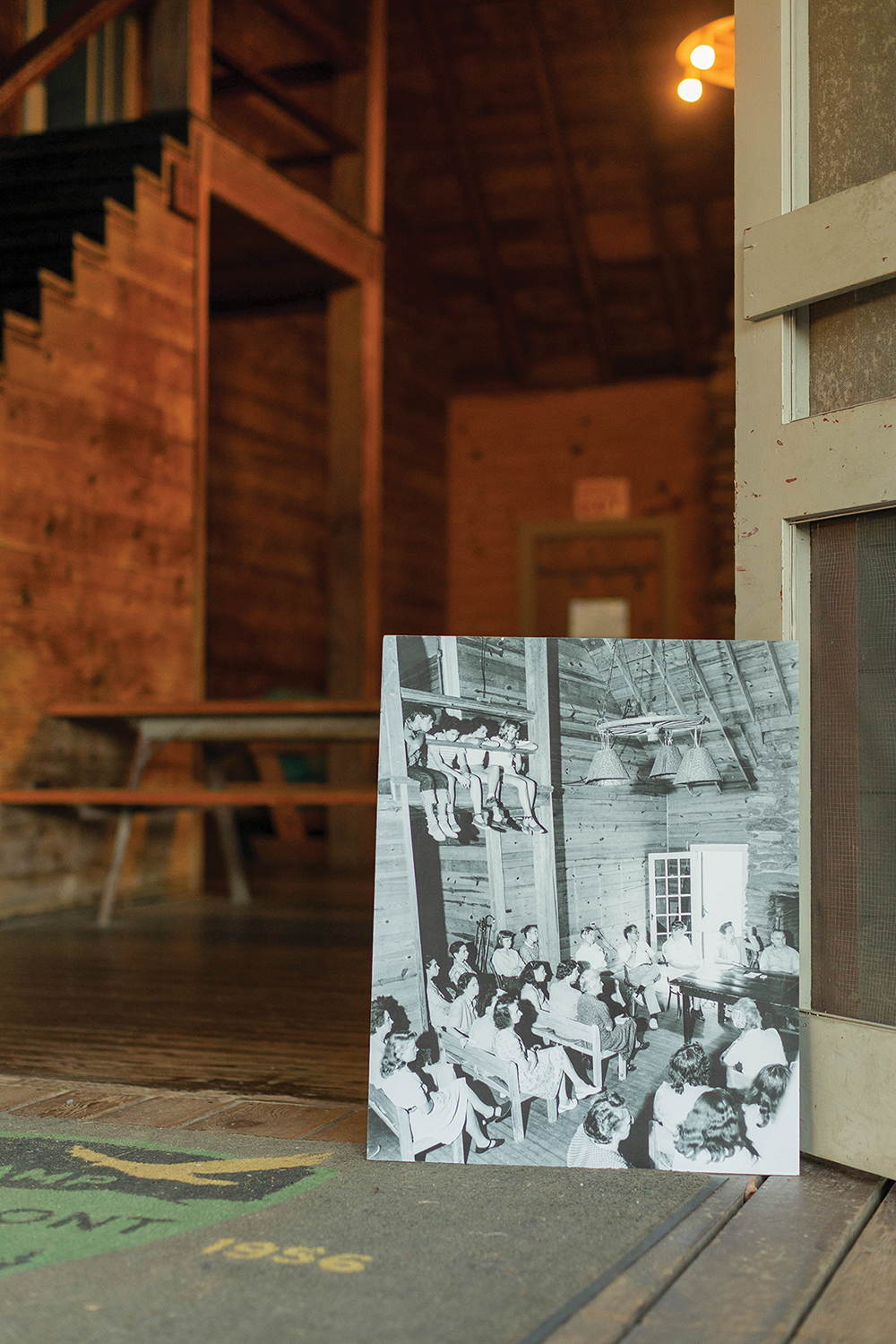
Photo by Colby Rabon
In 1944, Jean Charlot, an assistant to Mexican muralists Diego Rivera and José Clemente Orozco, was a guest painting instructor at the college. As a side project, he painted two frescoes, titled “Knowledge” and “Inspiration,” on the concrete pylons beneath the Studies Building. They are the last remaining examples of visual art on the campus, but as Sebrell explains, “Over the decades they became faded from exposure to the elements and further obscured by dirt and grime, until they were no longer as noticed and appreciated for their historic importance. They were covered in debris and insect nests, had gouges and divots in them, and someone named Ricky carved their name into one.”

Photo by Colby Rabon
So in 2020, conservators Craig Crawford and Maho Yoshikawa were hired to clean and restore them. Descriptive signage was added, along with barriers to protect them from environmental damage — and the conservators returned after Hurricane Helene to clean them yet again.

Photo by Colby Rabon
The Quiet House, a stone cottage tucked into the woods, was built by students and faculty members as a memorial to a child named Mark Dreier who died on campus in a tragic accident. His father, engineer and professor Theodore Dreier, was one of the founders of Black Mountain College. The small house was constructed by students and faculty as a place for reflection and meditation; it became a sanctuary for ceremonial events including the wedding of students Paul and Vera B. Williams. The Williams couple went on to establish the still-active artists’ co-op community The Land (aka Gate Hill Cooperative) in Stony Point, New York, considered an outgrowth of Black Mountain College.
Williams, who died in 2015 at age 88, graduated from Black Mountain College with a degree in graphic design and became an award-winning writer and illustrator of children’s books. She once said, rather in the rebellious BMC spirit, “A lot of childhood effort, worry, and whispering goes into the codes of adult life. Children have to be accomplished spies.”
Black Mountain College Museum + Arts Center hosts campus tours from 10am-noon, $20 per person, on the following Fridays: December 12, March 20, April 10, and May 22. For more information, see blackmountaincollege.org.