
Fiddle-tune expert shows another facet of his character

Photo by Lauren Rutten
Roger Howell’s family on both sides hails from rural Mitchell County, NC, which is also home to the historic Spruce Pine Mining District. But Howell was first drawn to minerals growing up in the Mars Hill area of Madison County, where he still lives.
“When I was a kid, the state and county road departments would drench out gravel from the Barnardsville area of Buncombe County to be used on the mostly dirt roads here in Madison County,” he explains. “When it rained, mica and little red pebbles of garnet and pretty blue kyanite would get washed out of the piles. I was five years old and I’d go out and pick them up, and that’s when I started collecting rocks.”
By fourth grade he was teaching himself geology from books. “I’d hit the mine holes by my grandmother’s house and go through the stuff the mines dumped and find beryl and quartz. I’d walk half a day to get to a little old mine on top of a mountain, carrying a rucksack.”

“Sink Hole,” “Abernathy,” and “Banner” were among the named mines near the community of Bandana, close to Bakersville where his grandparents lived. And while the world’s purest quartz, the source for the silica chips used in electronics, is still extracted from deposits in Spruce Pine, the mines Howell refers to are long gone.
“Once I found an emerald as big as my thumb,” he reveals.
In those days, many folks sought out “pen pals” with like interests to communicate with through the postal service. “When I was starting grade school I had rock-collector pen pals and they’d send me a 20-pound box of samples for three or four dollars. I got hundreds of rocks from France, Wales, New Zealand, South Africa.”

Musician Roger Howell started gathering locally found gems and minerals when he was a kid. His current collection numbers more than 10,000 pieces.
Photo by Lauren Rutten
He figures only about a third of his current holdings were purchased outright, although he did acquire a great lot in one transaction. Referencing Iwanna, Asheville’s former print publication for classified ads, Howell remembers “a fellow [who] had a collection he was selling from when he was in the Army in Europe.” Drawers full of gemstones from Austria, Poland, and the Czech Republic added up to about 4,000 pieces, he recalls.
“I bought everything.”
In his VW Beetle, he’d drive twice a week to the rock seller’s house. “His mother would feed me supper and I’d load the car down till it was dragging the ground.”
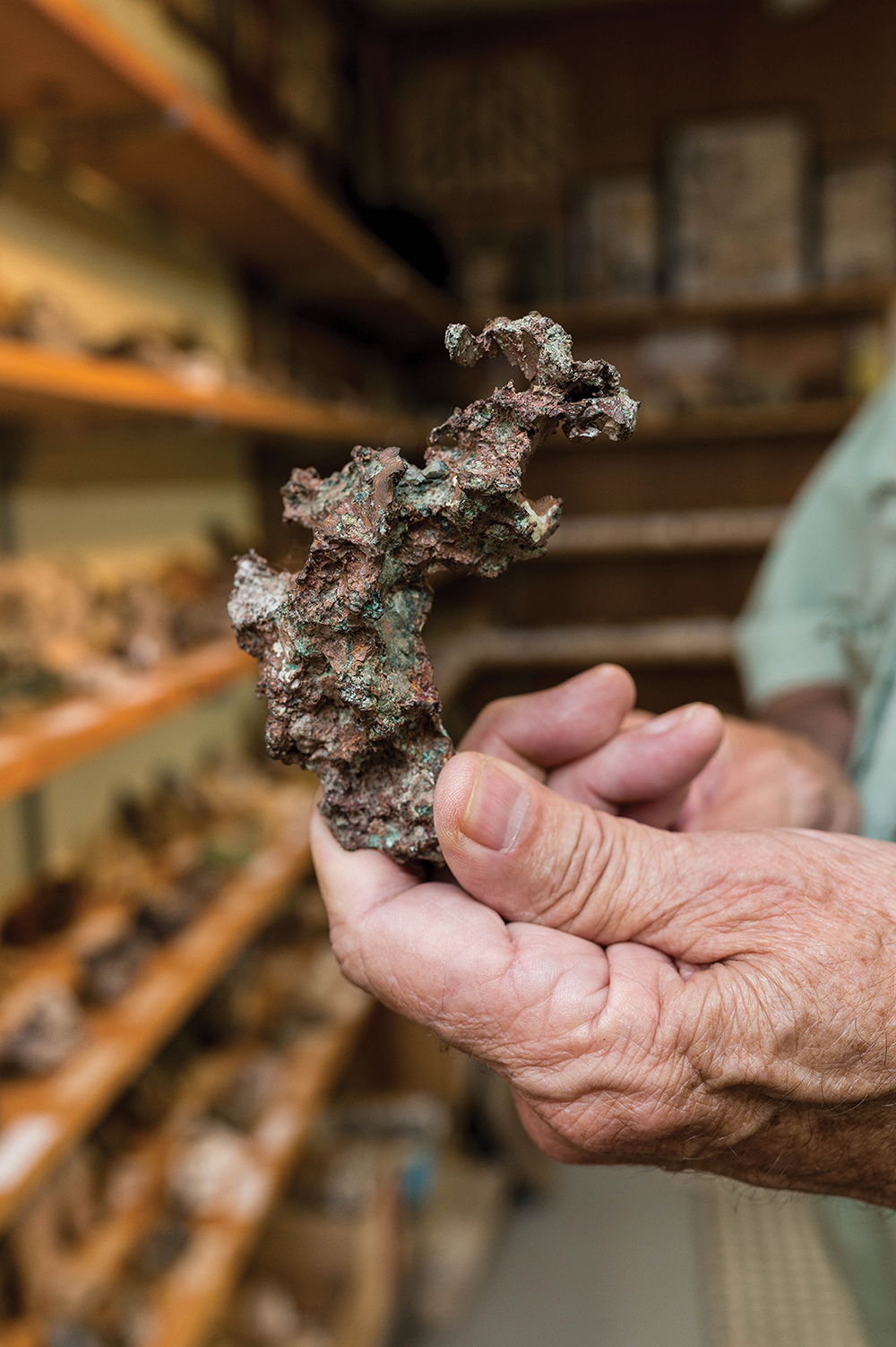
Photo by Lauren Rutten
Now Howell has a wall-to-wall, floor-to-ceiling collection so vast he is unable to count how many specimens it contains — but to date he has studiously cataloged more than 10,000 of them using laboriously typewritten labels. They’re kept in his dad’s old TV-repair shop. “I renovated it for a display room near my house,” he says. “Half is for minerals and the other half is for my fiddle-repair shop.” (Other gems are kept in boxes and bins in a barn on the property.)
For more than a century, the standard for classifying minerals was the Dana System, a scientific approach that uses factors such as chemical composition.
“It was mind-boggling,” says Howell. “Life’s too short. Even when computer databases came along, I never had time for all that.”

Photo by Lauren Rutten
And that’s largely because Howell became a celebrated musician — one who keeps an extraordinary fiddle collection, as well. “I kept on playing guitar and fiddle till it took over and put my rocks on the back burner,” he remarks. Howell regularly played at Zuma Coffee in Marshall with his close friend, Bobby Hicks, a Grammy Award-winning fiddler who passed away last summer at age 91.
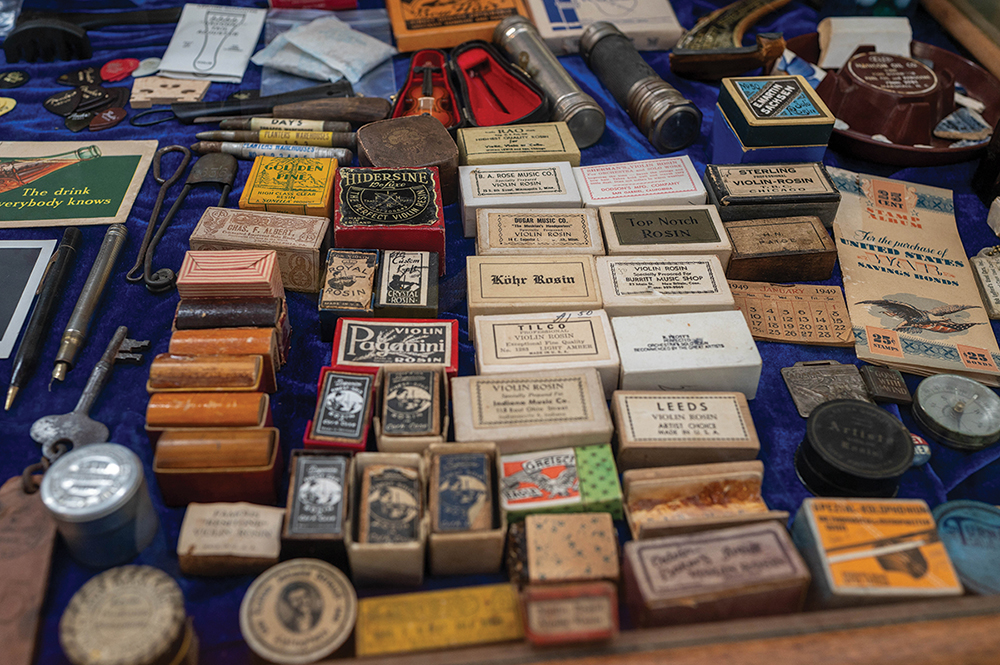
His reputation for restoration and repair of violins is world-class — attracting visitors and customers from across the region, the nation, and from Japan, New Zealand, and the British Isles.
Perhaps most impressive, though, is Howell’s “collection” that comprises the riches of his musical memory. He has recorded more than 650 “fiddle tunes” — a name for string-band or “old-time” songs handed down via oral tradition — to the archives at Mars Hill University; they’ve since been distributed to seven other universities.
In 2015, the North Carolina Folklore Society honored Howell with the prestigious Brown-Hudson Folklore Award for his work preserving and celebrating mountain-music traditions. The documentary film A Mighty Fine Memory, about Howell’s encyclopedic knowledge of fiddle tunes, was produced by the Liston B. Ramsey Center for Regional Studies in conjunction with MHU’s Lunsford Festival in 2015. Howell met the festival’s namesake folklorist Bascom Lamar Lunsford (1882-1973) at the first event some 60 years ago, and has attended every edition since.
Meanwhile, he says, “I have to do something with my rocks — but I haven’t decided what.” No matter where it’s from in the world, “any specimen from a mine no longer in existence is so much more valuable today than it was 50 years ago,” he explains.
“I’ve got four or five that are one of a kind. Nobody else has ever found them.”
To contact Roger Howell, email fiddler49@gmail.com.