
Artist shows a seasoned pastiche of earthiness and fantasy

Cynthia Brody uses the flora and fauna of her new home to enhance the narrative in her multimedia works.
Photo by Rachel Pressley
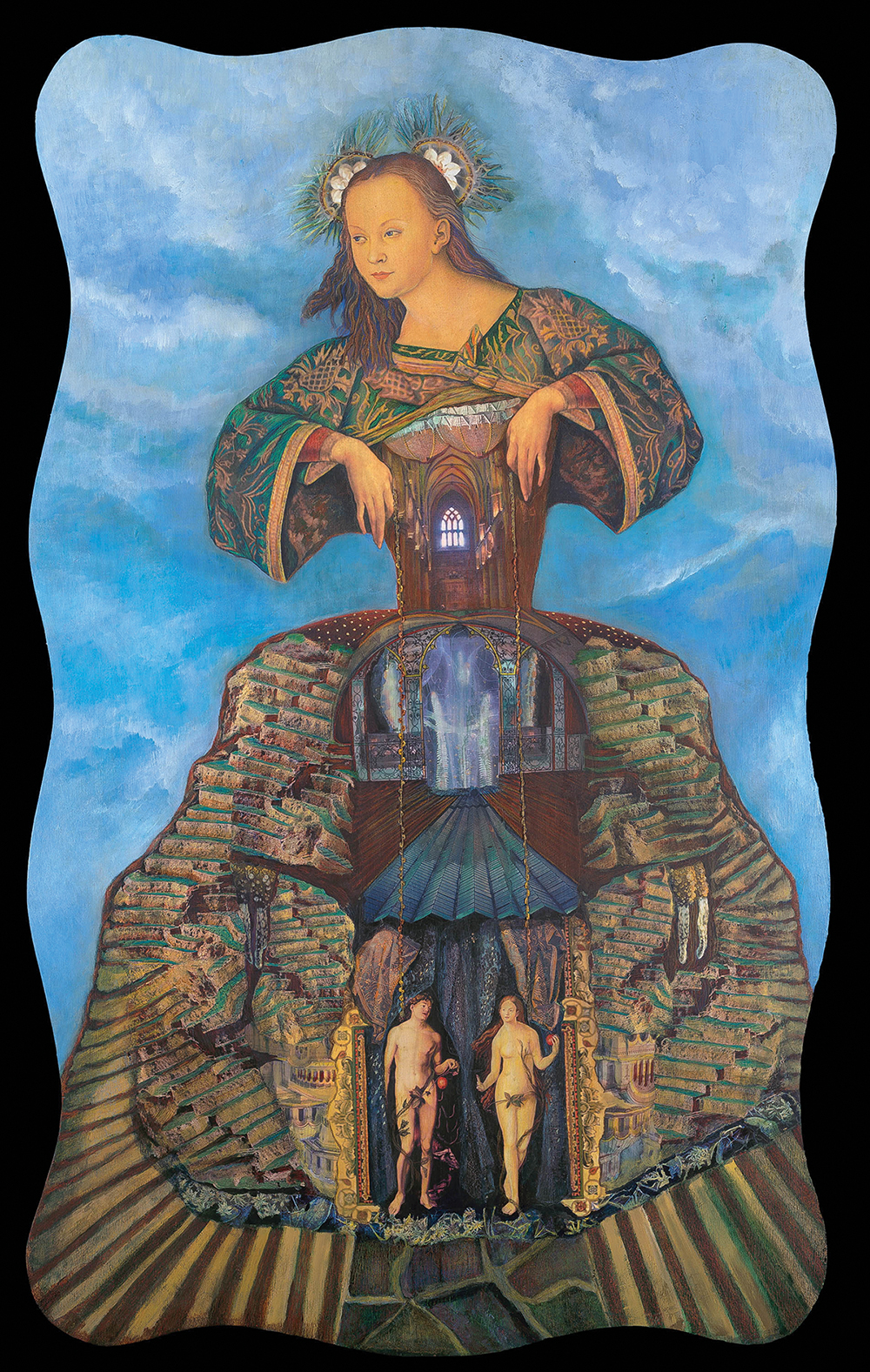
Cynthia Brody took a few art courses in New York while she was raising her children, but her exhibited technique of more than 50 years is largely self-taught. She creates mixed-media art using diverse materials including photography, acrylic and oil paint, and gold leaf. Her method turns commonplace imagery into elements that are fantastically surreal, yet harmoniously grounded in fauna and flora.
When Brody first started out as an artist, nothing was digital. To achieve her vision she built multiple layers of collage from printed materials. But with the advent of technology, a whole new dimension of possibilities opened up for her. “I am able to morph and change photos until I get images I like, then print them out and glue them to a canvas where I’ve already painted the face and loosely sketched the figure,” she explains. She finishes her signature portraits of women — an ongoing commentary on the female experience — by connecting the materials and embellishing them with paint.
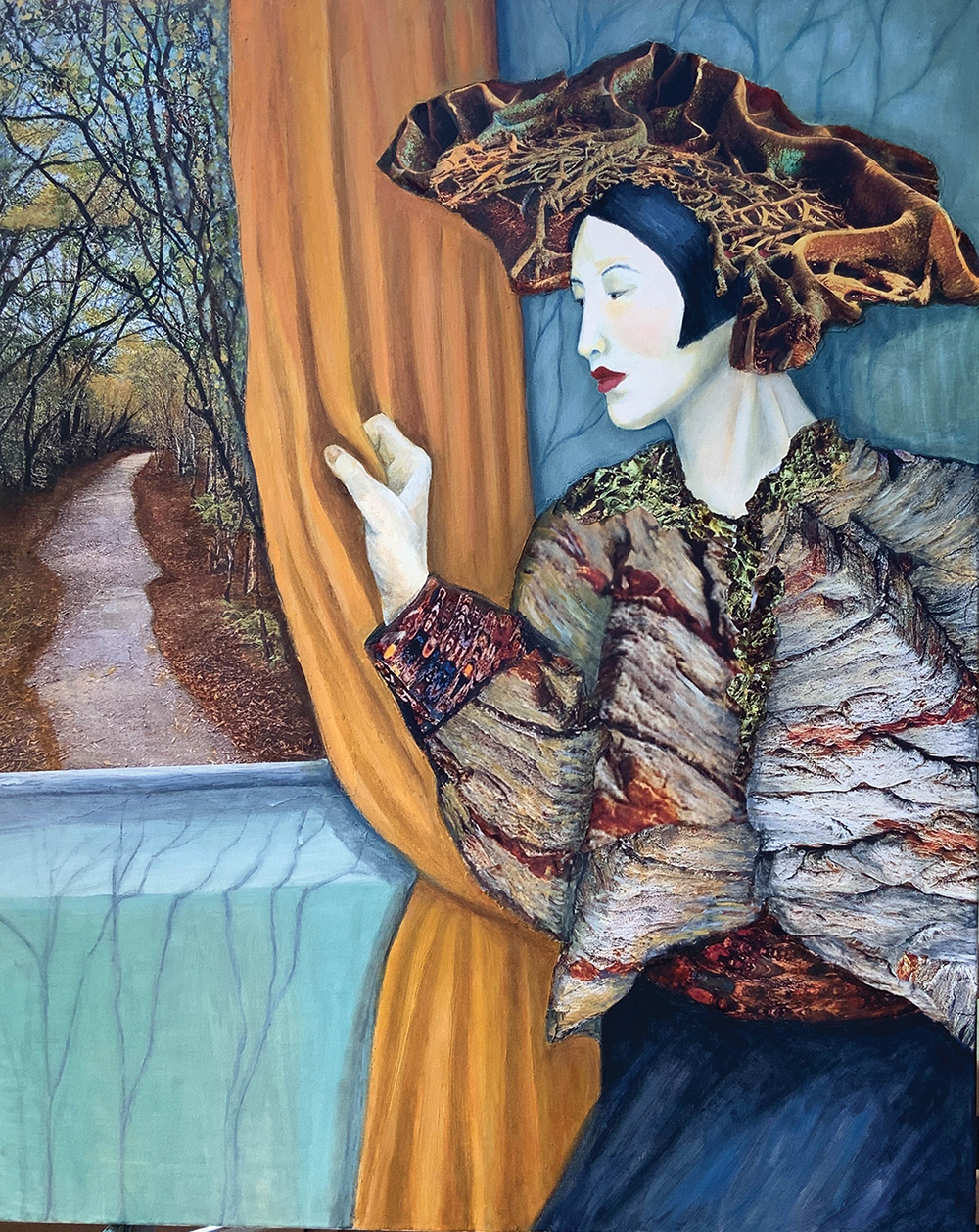
Brody’s playful approach teases the viewer to pay closer attention and discover that not everything is what it seems at first glance. Obvious textiles might actually be images of wood or lichen. A necklace may be a network of subterranean tree roots; a skirt may be conjured from wildflowers or insect wings. Brody weaves her imaginative elements into lyrical compositions, until the whole is delightfully greater than the sum of its parts.
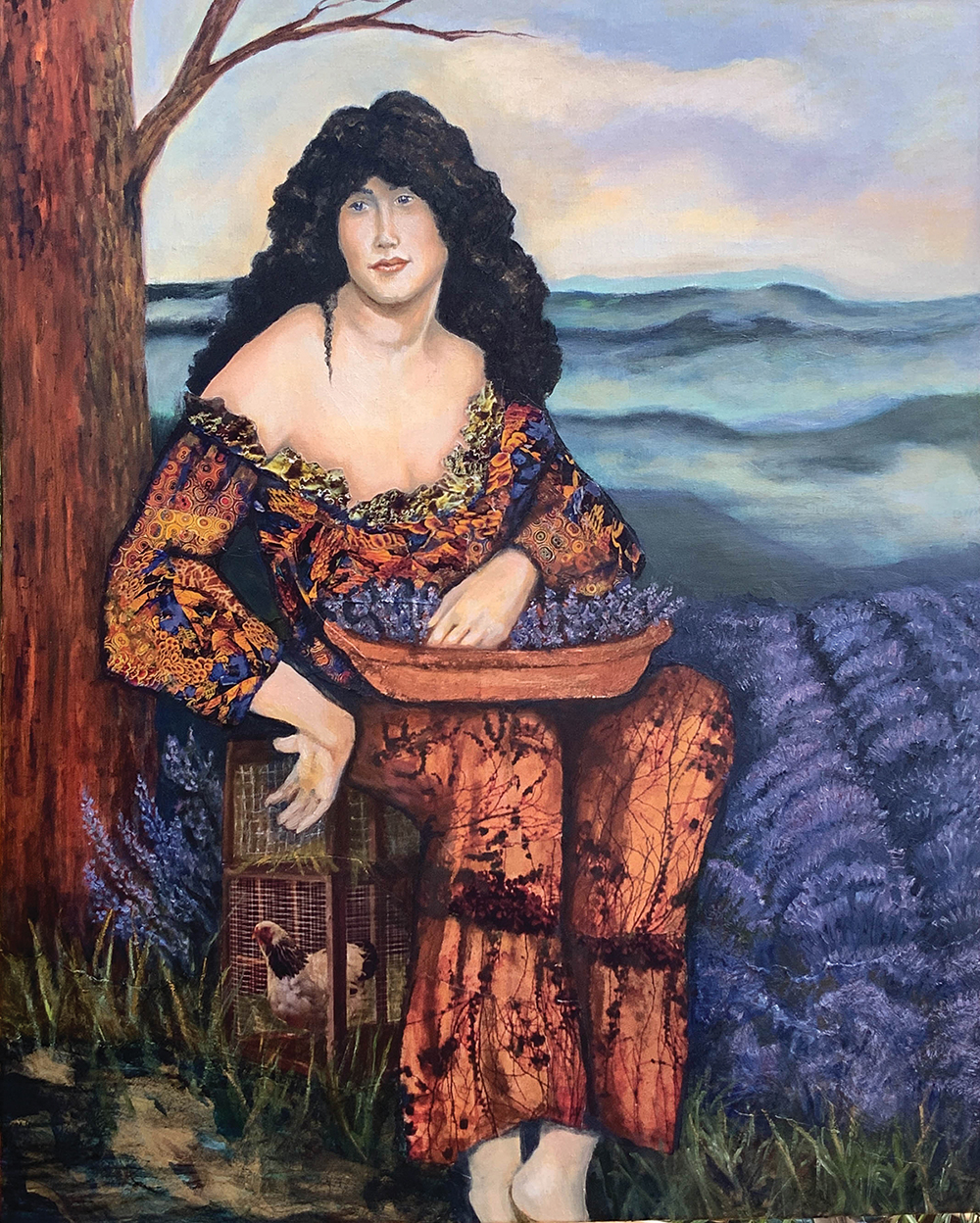
The process is time consuming, but Brody says that allows her to become more acquainted with the women who inhabit her canvases. While partway through a piece inspired by the circa-1870 Henri Regnault painting “Salomé,” Brody uncovered an unsettling fact. Salomé was a Biblical figure whose mother got divorced and remarried her brother-in-law — a union condemned by John the Baptist. Her stepfather was the king, and when he granted Salomé a wish as a reward for her hypnotic dancing, she revengefully requested the head of John the Baptist delivered on a platter.
“I realized that my painting was glorifying the most horrible monster,” Brody says. “But it occurred to me that I could use my art to help Salomé see the error of her ways and become a peaceful person.” In Brody’s symbolic interpretation, “Salomé in Appalachia,” the backdrop is the soothing beauty of fog-draped mountains, and freshly harvested lavender fills the wickedly infamous platter, representing a conversion to peace and tranquility.
The painting also serves as an aesthetically pleasing counterpoint to these troubled times. “There is a lot of turmoil in the world, and I am very disturbed that people get into positions of power and do evil instead of good. So I thought it was important to do something artistically to make a statement about that.
“Life is a combination of beauty and awfulness, and I try to find a way to put that together so that the beauty draws you in.”
But Brody hasn’t always been comfortable painting beautiful pictures. Her parents were Holocaust survivors, and for a long time that emotional weight made her feel that as an artist she shouldn’t be celebrating beauty.
“Then I attended a meeting of Holocaust survivors and children of survivors, and they all talked about their writing, poetry, and art.” That gathering inspired Brody to devote seven years to editing an anthology, Bittersweet Legacy (University Press of America, 2021). Within its more than 300 pages, writers and artists respond with deep eloquence to the Holocaust, and the book has received high praise from Michael Berenbaum, who spearheaded the establishment of the U.S. Holocaust Museum. Bittersweet Legacy continued to have a positive multiplier effect through school presentations and gallery exhibits, and the project gave Brody a sense of healing closure. “I felt that I had finally done what I was supposed to do to ensure that people remember the Holocaust and never forget it, and I decided that going forward I would make the most beautiful art I possibly could.”
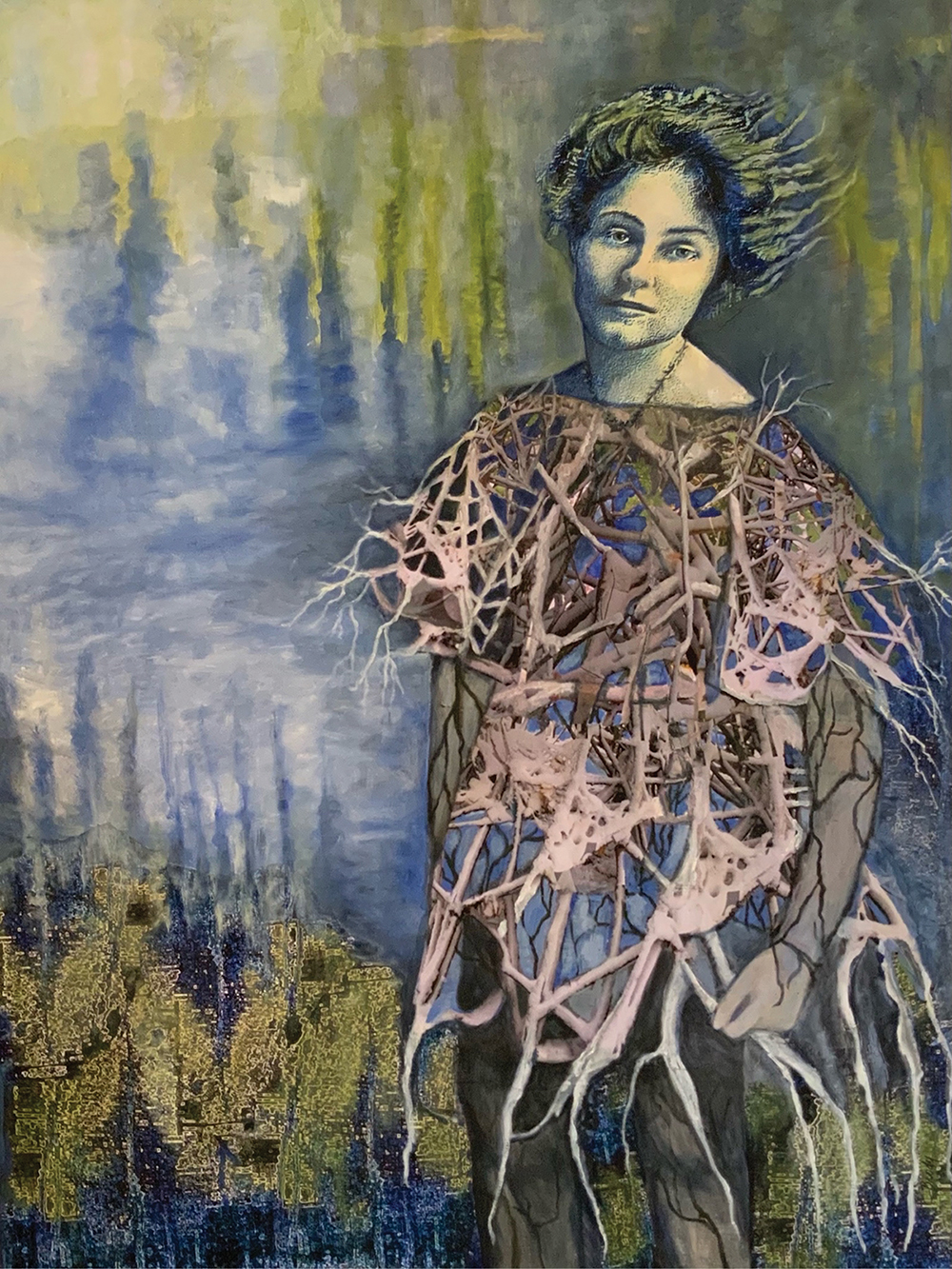
Brody — who is also a licensed psychotherapist — moved from Boston to Asheville in 2024 with the goal of refocusing on her art, and the relocation is vividly reflected in her recent work. “I’ve always portrayed women, but now I put them in a Southern Appalachian environment.
“And I never imagined that I would paint bears, until I found one living in my backyard — as it ran toward me at full speed.”
Cynthia Brody, Asheville, cynthiabrodyart.com and on IG @cynthiabrody and Facebook (cynthiabrodymixedmediaart). Brody’s work is represented by Asheville Gallery of Art (82 Patton Ave., ashevillegalleryofart.com); ReImagine Gallery & Studios in Fairview (15 Spivey Lake Drive, reimaginefairview.com); and The Center for Conscious Living & Dying (83 Sanctuary Road, Swannanoa (ccld.community).