
Artist is known for her prolific flocks of porcelain birds

Potter Lucy Dierks studies birds and renders them in a notoriously tricky medium before glazing the results in saturated festive colors.
Photo by Lauren Rutten
Lucy Dierks’ introduction to pottery came from a course at a recreation center, where her first teacher “wasn’t really a fan of mine,” she says, “because I was too messy.”
But switching teachers, she had the great fortune to be taught by a graduate of Alfred University, the small school in New York State that boasts perhaps the finest ceramics department in America.
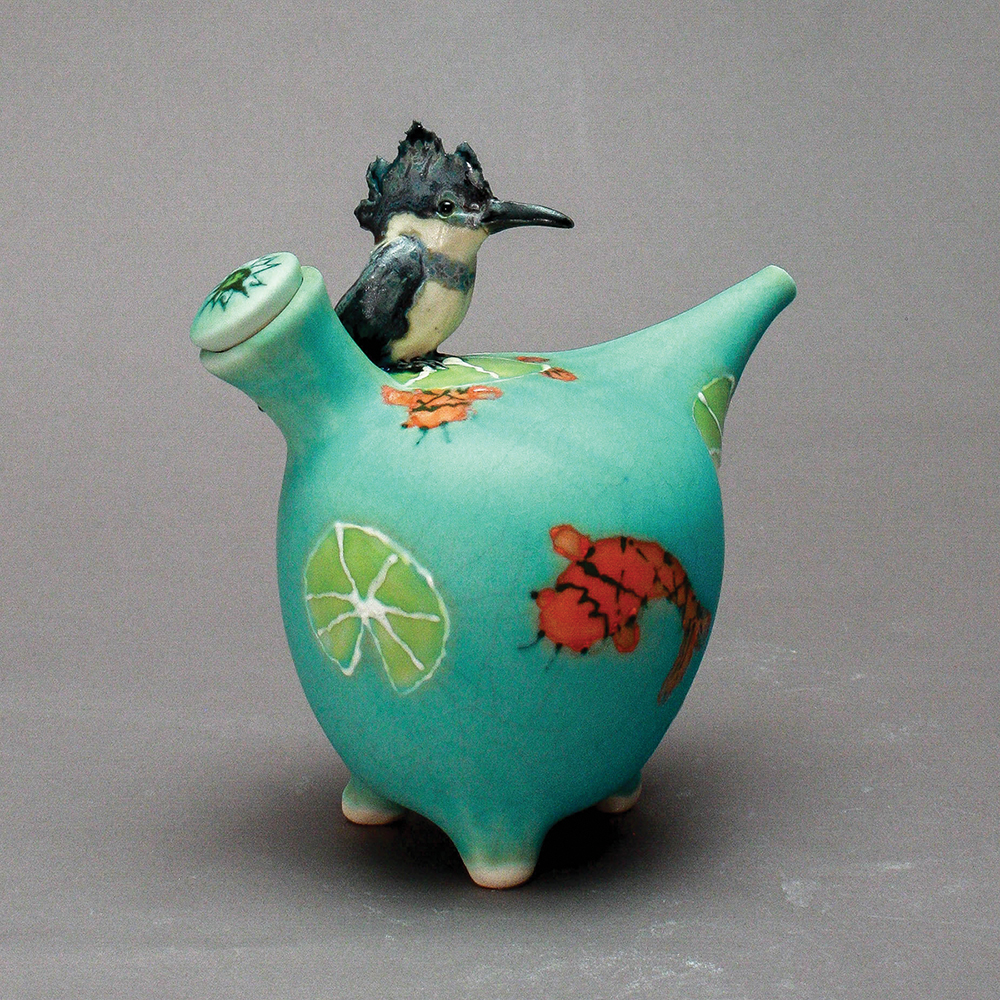
“He got what I was trying to do, and encouraged me to play.” She also got a huge boost by attending an intensive 8-week program at Western North Carolina’s renowned Penland School of Craft, which now represents her work.
“When I got to Penland, I felt like I’d found my people and come home. It was really fun and I learned a lot.”
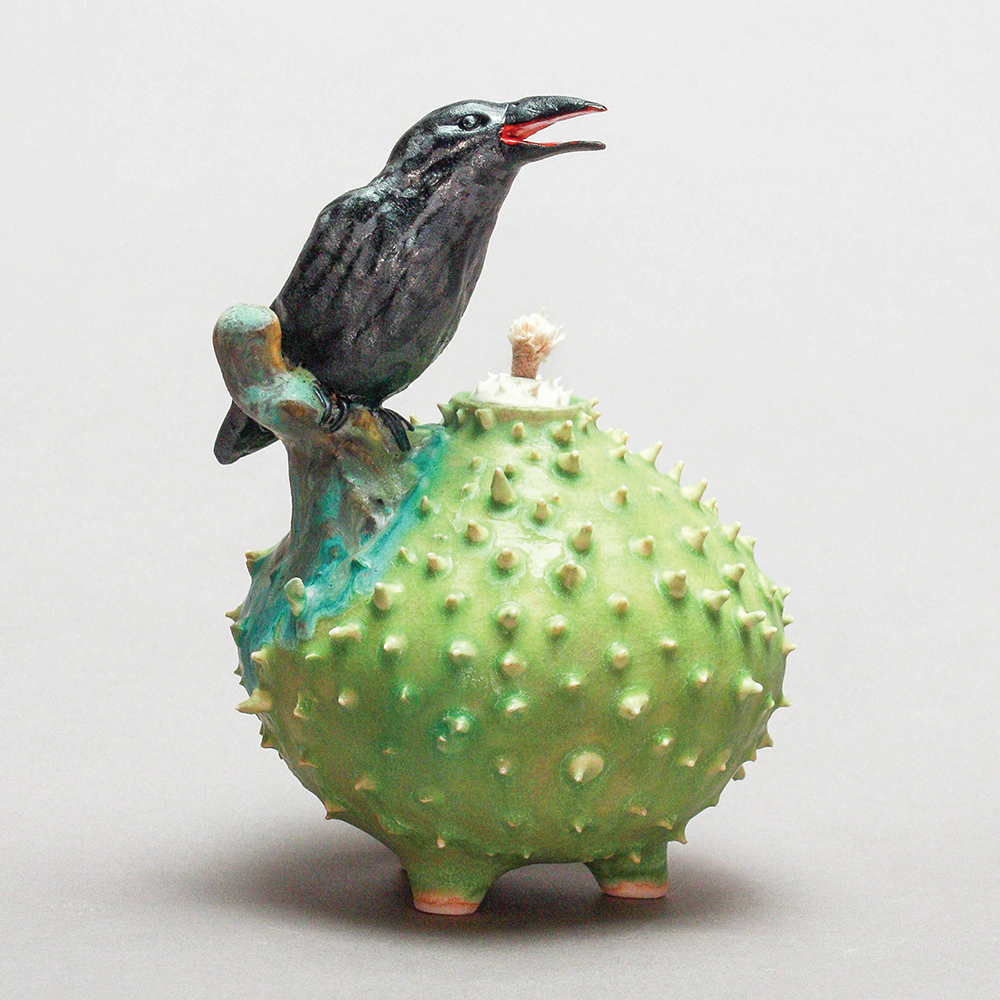
Now the Asheville artist gets to play every day, and confides that birds speak to her. Maybe not literally, but definitely figuratively. Dierks sculpts flocks of them into fine-feathered figures that are perched with attitude on almost every piece of her prolific pottery portfolio, as colorful conversation starters and invitations to contemplation.
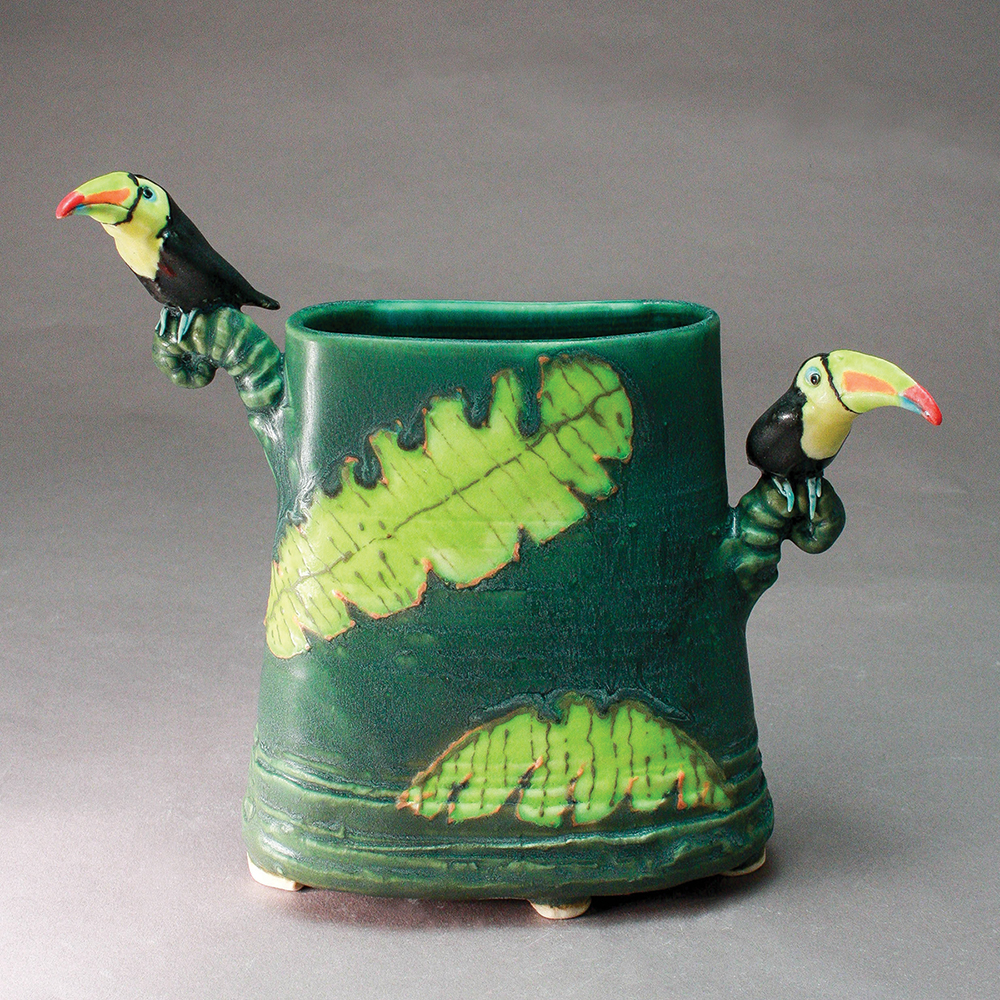
“I enjoy thinking about the birds I sculpt and where and how they live, and I’m fascinated with the contradictory aspects of their bodies. It intrigues me that birds can be so light and dainty, yet strong and fierce.”
Dierks leans in the direction of an ornithologist, intrigued by the science of birds. But a scientific lens is an unavoidable prerequisite for success in ceramics, a pursuit that requires a passion and curiosity for experimentation and a working knowledge of chemical formulations. That’s especially true for Dierks; her preferred medium, porcelain, is a notoriously finicky material that requires constant adjustments of kiln-firing temperatures and procedures, as well as creative tweaking of recipes for glazes.
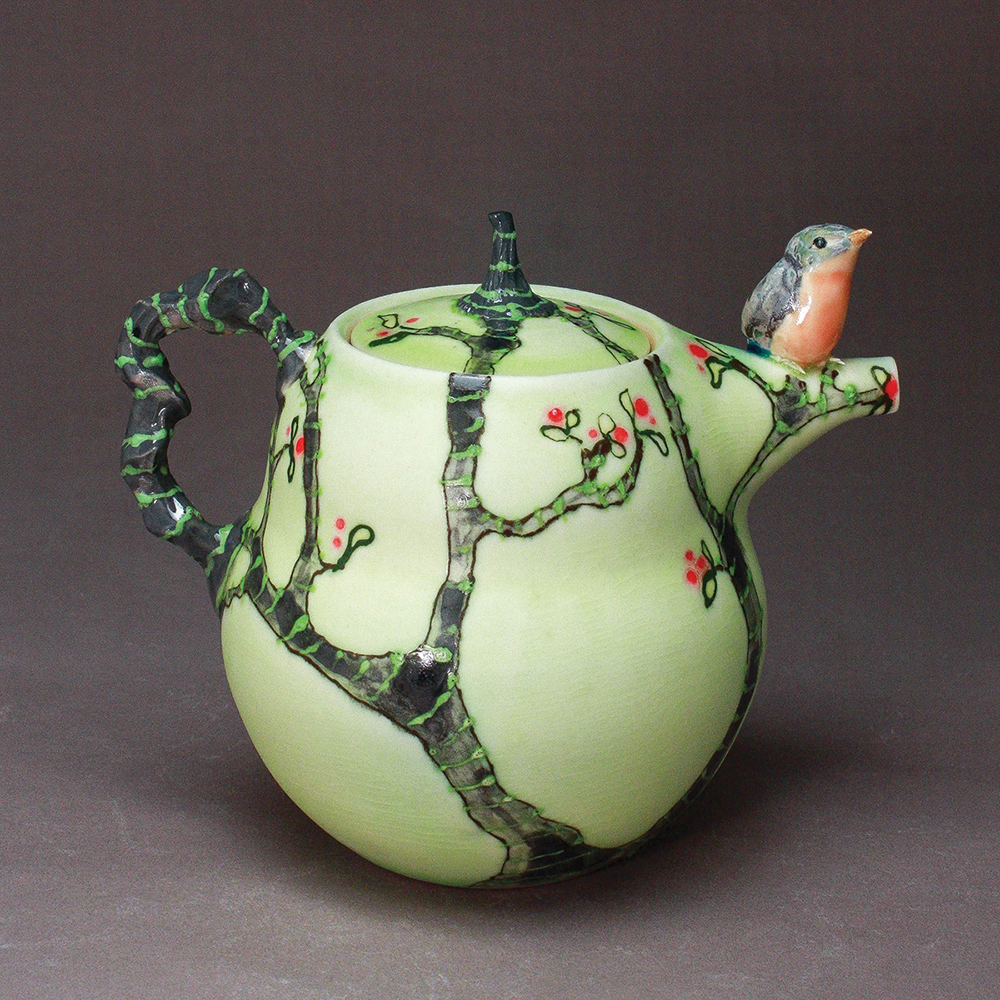
The artist learned by trial and error when to form the most delicate part of the bird on its perch.
A resilient mindset also helps, since clay and glazes often exhibit a mind of their own that can trigger unwanted outcomes and perplexing failures. Every potter experiences the exciting anticipation of placing vessels that represent many hours of meticulous labor into the kiln, only to open it later to the heartbreak of cracked, deformed, or discolored results.
But Dierks embraces challenges, inviting them to nest in her studio. During the COVID shutdown, she had extra time to deepen her craft. “I decided to switch things up to make my pieces more complicated. Now I’ll take a piece and throw it on my kick wheel, then cut it apart and put it back together. I’ll make pieces that have four or five different components, and I’ll paint each part with different glazes.”

If the clay of those various parts doesn’t reach the same level of dryness, the incompatibility can cause the piece to crack or fall apart — and preventing that is a delicate balancing act. Dierks also learned to place the feet of the bird first on the vessel’s perch. “They will sometimes curl up and do weird things, so you have to manage that, too. There are so many steps involved, but I like that because I am building up a history in each piece.”
Similarly, she builds color in layers, both subtle and bold, hand painting each bird with five or six different hues and shades of glaze.
Dierks holds a Master’s Degree in Learning Disabilities Education, but has no formal training as an artist. “All of this is done by the seat of my pants,” she admits.
Nevertheless, she has a remarkable talent for winging it. She sculpts and paints birds of every stripe, each with its own unique and vivid personality. Some of her vases, teapots, bowls, boxes, lamps, and other vessels are adorned with orioles, chickadees, robins, crows, toucans, owls, bluebirds, sparrows, woodpeckers, cardinals, wrens, and thrushes. Others sport lesser-known exotic breeds such as hoopoes, bulbuls, and manakins.
Dierks mixes all of her glazes herself, creating exquisitely textured surfaces that mimic natural features like tree bark, vines, stone, or lichen. Her method for painting the watery interiors of pieces is to fire the glazes until they develop a glassy aesthetic with visual depth. To do so, she operates the kiln through a specific sequence of temperature changes until an organic crystalline structure develops, producing fabulous patterns of visibly intricate crystals.
Dierks cites Asian art and ceramics as a major influence. At press time, she’d recently gotten back from a visit to Japan, where she toured studios and galleries — returning with a wealth of inspiration to take flight into the New Year.
Lucy Dierks, Asheville, lucyvdierks.com and on IG @lucyvdierks. Dierks’ work is represented by Penland School of Craft Gallery (3135 Conley Ridge Road in Penland). Her work is also on display at Blue Spiral 1 (bluespiral1.com).