
How slope and symbolism shaped a modern ridgetop build
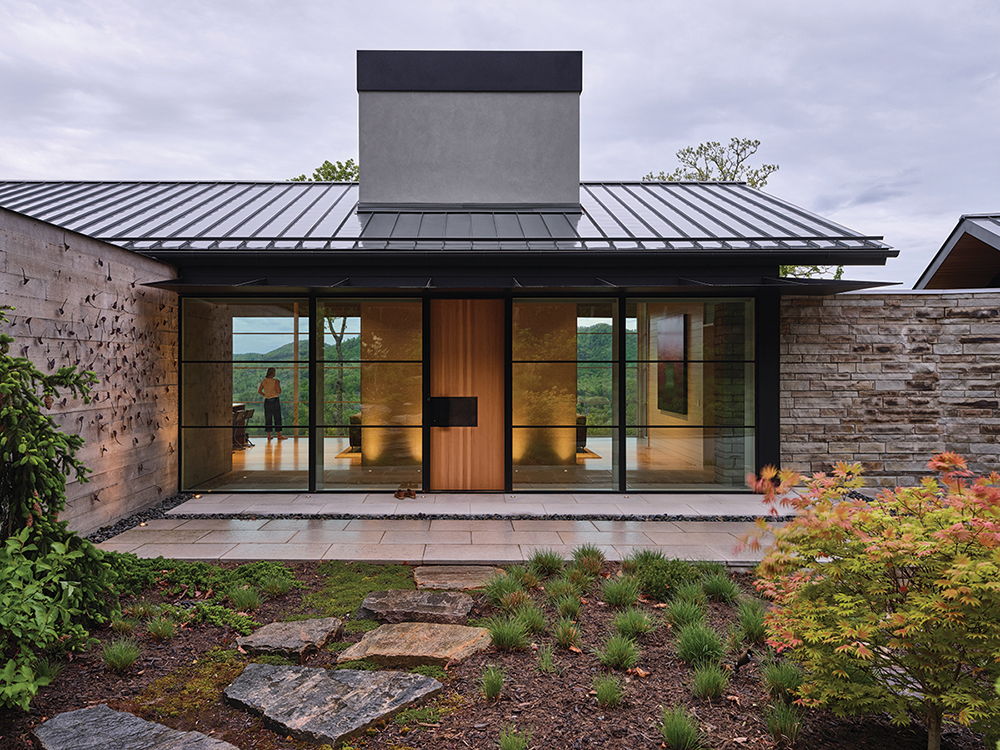
Photo by Keith Isaacs
More than 200 million years ago, long before dinosaurs roamed the Earth, the ginkgo tree took root and held fast, surviving shifting continents, ice ages, and extinction events that erased entire species. Today, the ancient tree is often described as a “living fossil,” its fan-shaped leaves a symbol of resilience.
That enduring strength resonated with the owners of this nearly 5,800-square-foot home. Originally from Hong Kong and now splitting their time between North Carolina and New York, the husband and wife were drawn to the tree’s quiet strength — a fitting parallel for a project that would demand patience, resolve, and a willingness to build where others might not.
According to Dan Collins of Glennwood Custom Builders, the couple’s lot was far from straightforward. Perched on a high ridge in an Asheville golf community, the heavily wooded two-acre parcel was subject to steep-slope regulations, which limited both land disturbance and impervious surface area. Add to that neighborhood-mandated roof pitches, and the design vocabulary narrowed quickly.
“It was a very steep lot, so we had a lot to contend with,” says Collins.
Rather than push against those constraints, Collins partnered with Architect Scott Huebner, AIA, of Harding Huebner to translate limitation into form. The result is a home that stretches laterally along the ridge, its long, linear profile arcing gently with the slope.
“The land was a driver of the design,” says Huebner. “The home was born out of the topography.”
For the interiors, Huebner called upon Traci Kearns, owner and creative director of Alchemy Design Studio. After spending time getting to know the clients, Kearns developed a palette grounded in natural materials and disciplined transitions. White-oak floors run throughout the main level, while a walnut ceiling detail in the great room introduces warmth without ornament. In the kitchen, painted perimeter cabinetry balances a sculptural walnut island, its grain adding depth to an otherwise streamlined composition.
“There’s this sense of calm,” says Cris Bifaro of Cris Bifaro Woodworks, whose team fabricated much of the cabinetry and several custom furnishings throughout the home. “Nothing shouts. Nothing distracts you.”
That serenity extends beyond millwork. Plaster wall finishes by Eli Orling soften light as it moves through the space. Custom steel details by OK Goods provide subtle contrast without tipping into industrial excess. Even the entry door, crafted by Loud Woodworks, reinforces the home’s quiet material dialogue.
And then there’s the ginkgo.
At the front entrance, a custom copper and brass installation, designed by Huebner and Kearns and fabricated by Asheville metalsmith Zach Noble, features a series of ginkgo leaves that appear to drift across a concrete wall. Set slightly off the surface, the leaves cast shifting shadows as the light changes throughout the day. From inside, they read almost as if they are blowing in from the surrounding woods.
“The leaves add a distinctive natural element,” Noble says. “They bring a light, calming quality to the front entrance and create curiosity when you see them through the windows from inside.”
The motif continues in subtler ways. In the powder room, a custom concrete inlay bears the imprint of a single ginkgo leaf. In a guest bedroom, a subtle wallpaper echoes its familiar fan shape. The repetition is intentional but restrained — a thread rather than a theme.
“When a project is successful, you can see the clients’ personalities reflected in the space,” says Kearns. “I feel like this project was successful in that way because there’s a quietness to the space — there’s nothing overbearing or in your face.”
Huebner agrees, adding that the home embodies “quiet refinement.”
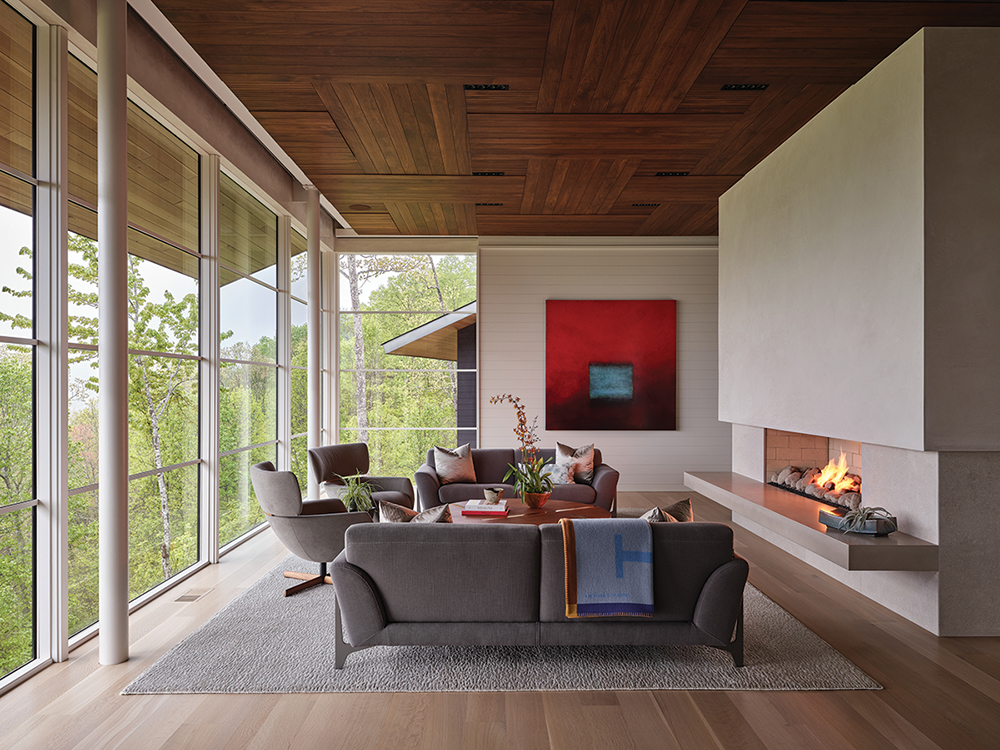
Ceiling as Statement
In the great room, a quilted walnut ceiling is both a focal point and a feat of craftsmanship. Architect Scott Huebner designed the detail to hide structural beams and give the space “more life and texture.” Builder Dan Collins of Glennwood Custom Builders notes that “a lot of time and effort” went into laying out boards of varying widths and thicknesses with integrated lighting woven throughout.
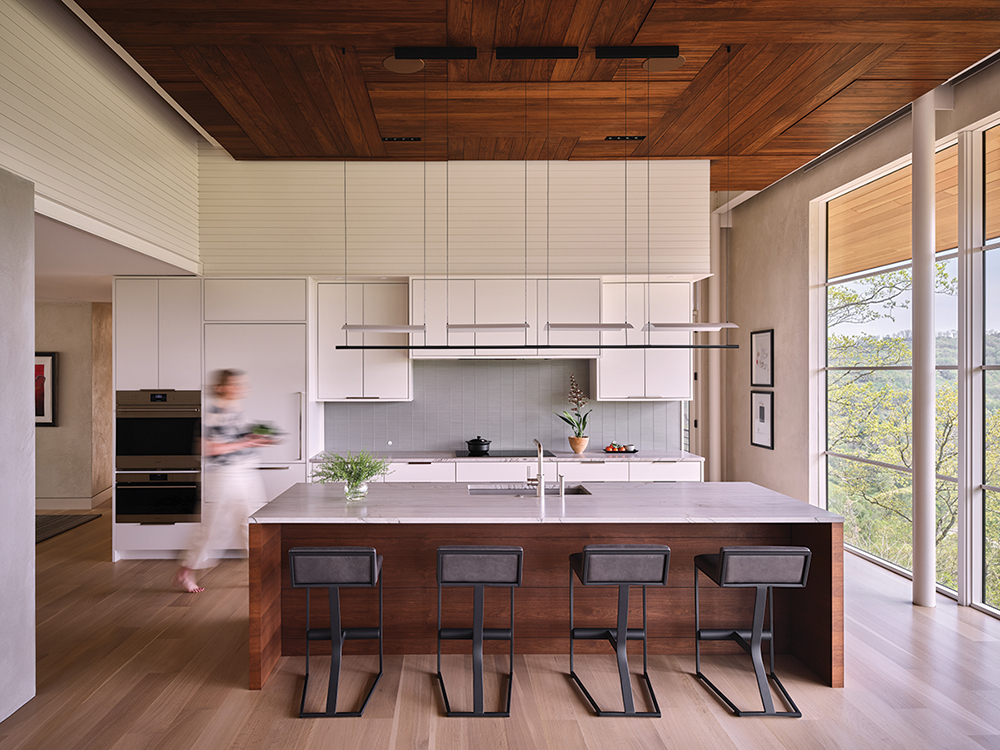
Composed Confluence
To unify the kitchen’s mix of materials, cabinetry by Cris Bifaro Woodworks was painted Sherwin-Williams “City Loft,” a warm off-white with beige and red undertones that allows the quilted walnut ceiling to remain the focal point. A contrasting walnut island, natural stone countertops from Mountain Marble, and a Sonoma glass-tile backsplash add texture, while stools sourced from South Africa complete the layered composition.

Headboard as Horizon
In the primary bedroom, a custom walnut headboard becomes both a focal point and a quiet architectural gesture. Designed by Harding Huebner in collaboration with Traci Kearns and the team at Alchemy Design Studio, and fabricated by Cris Bifaro Woodworks, the installation begins with tightly spaced vertical slats that gradually widen as they extend toward views of the valley below.
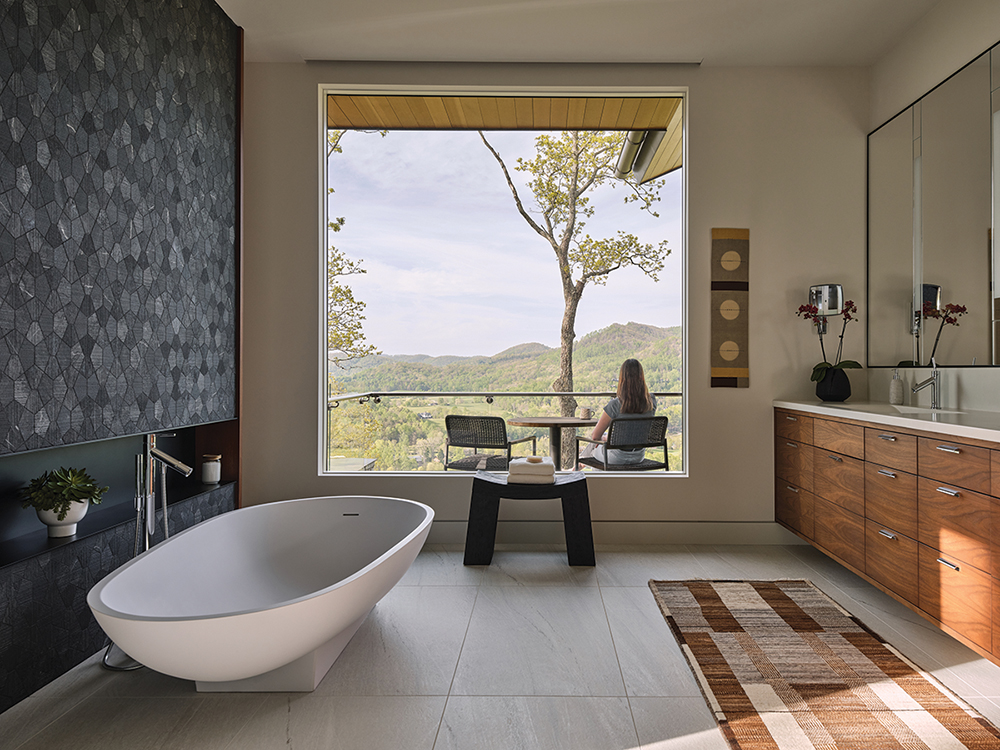
Serenity, Sculpted
In the primary bath, restraint gives way to quiet drama. A sculptural soaking tub by Agape anchors the room, set before a richly textured tile wall from AKDO. “It was a contemporary take on the pebbles and rock forms found in the Japanese garden,” says interior designer Traci Kearns. Walnut cabinetry and large-format porcelain flooring temper the darker palette, while a custom steel niche by Daniel Marinelli of OK Goods introduces subtle contrast.
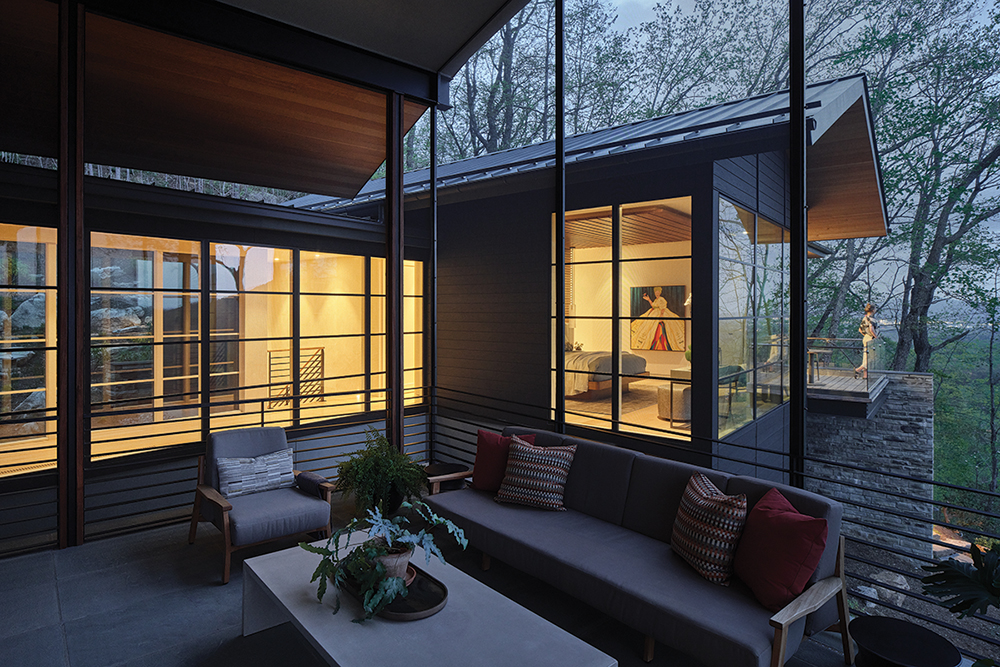
Suspended in Air
Hovering above the steep slope, the screened porch appears almost weightless. Builder Dan Collins says the entire structure is cantilevered from a single board-formed concrete pier, a structural move designed to minimize site impact while preserving views. The support is nearly invisible from below.
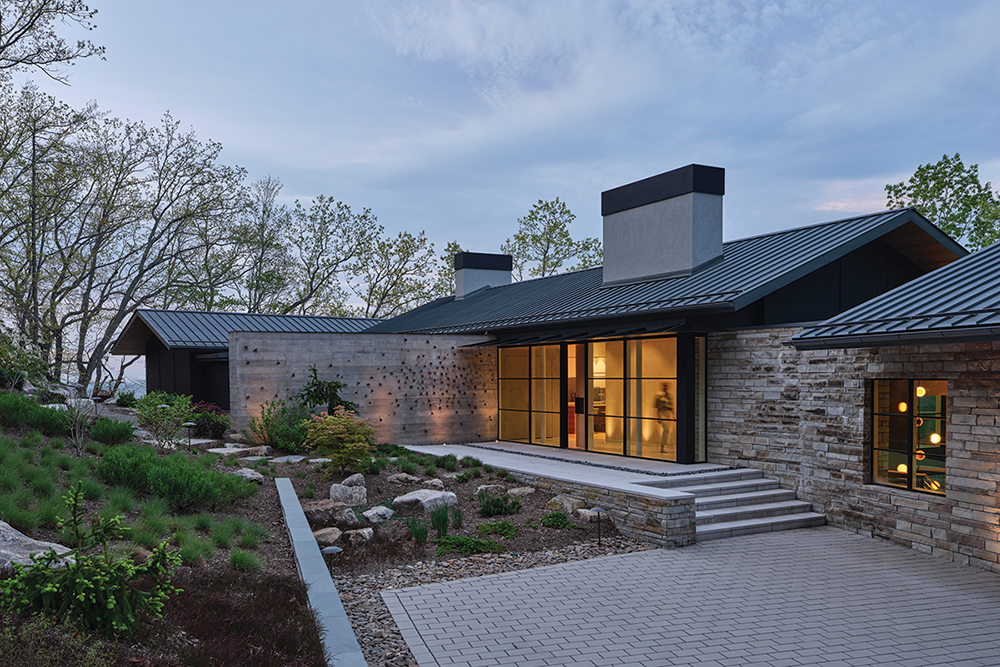
Weathered Welcome
At the front entrance, board-formed concrete creates a crisp backdrop for copper and brass ginkgo leaves forged by local artisan Zach Noble. He notes how the forms catch light and cast shifting shadows, and that the installation will evolve over time as the copper patinas. “Ginkgo trees drop most of their leaves in a one- to three-day span in autumn,” says Noble, reflecting on the beauty of a moment that is both brief and unforgettable. Custom rockwork by Independent Stonework of Brevard.
Resources:
Architect: Scott Huebner, AIA, Harding Huebner (Asheville)
Interior Designer: Traci Kearns, Alchemy Design Studio (Asheville)
Builder: Dan Collins, Glennwood Custom Builders (Hendersonville)
Cabinetry: Cris Bifaro, Cris Bifaro Woodworks (Asheville); Joe Martin, International Cabinetry (Hendersonville)
Custom Woodwork & Furniture: Jeremy French, Making Whole (Asheville); Cris Bifaro, Cris Bifaro Woodworks (Asheville)
Custom Steel: The Heirloom Companies (Campobello, SC)
Custom Entry Door: Lou Gargiulo, Loud Woodworks (Asheville)
Fire Pit: Hoss Haley (Asheville)
Plaster Finishes: Eli Orling, Orling Finishes (Asheville)
Custom Steel Fabrication & Lighting: Daniel Marinelli, OK Goods (Taylors, SC)
Landscaping: Gardenology (Asheville)
Stone: Independent Stonework (Brevard)
Fine Art: Entry Sculpture — Zach Noble Metalworks, Asheville; Paintings — Scott Upton via Blue Spiral 1 Fine Art + Craft, Asheville; Fiber Art — Rachel Meginnes via Tracey Morgan Gallery, Asheville; Ceramics — Eric Knoche via Blue Spiral 1.
Light Fixture in Stairwell: Hayden Wilson (Asheville)