
Blacksmith’s large decorative works span the Carolinas

Blacksmith Bill Crowell’s work is a fixture at local equestrian estates.
Portrait by Rachel Pressley
In the whirlwind of changing times, there’s something to be said for solidity. Few things communicate stability as unequivocally as iron and steel, shaped in heat and flame before assuming the forms that will remain for decades to come. Blacksmith Bill Crowell, proprietor of Saluda Forge, knows this better than anyone: Over the span of 30 years, he’s left a handcrafted legacy in homes and businesses throughout the mountains.
Much of his signature, decorative work announces point of access for high-visibility or elevated spaces. But he began with small, strictly useful items — hooks, brackets, and related hardware — and utilitarian furniture.
“I was forty years old when I started the business in 1995,” Crowell says. “I started out making tables and holders for flower pots, handrails, and so on.” These days, Crowell is known for more elaborate work, including embellished fire screens, impressive entry gates, and garden sculpture. “Ninety per cent of my work is privately commissioned,” explains Crowell, although he still maintains a small retail area in his 2400-square-foot workshop on Ola Mae Way, atop a hill overlooking downtown Tryon, on what used to be a coal yard adjacent to the railroad tracks which still run through town.

The business was launched, though, in rented space in Saluda, and as a favor to Crowell’s late wife, the tile artist Kathleen Carson, whom he met after he moved to Tryon from Charlotte, and she from New York City. “She asked me to make her a metal table for the tiles, so I said sure,” recalls Crowell — even though he’d never been near a forge in his life. A friend mentioned a forge in Saluda that had been laying idle for some time, so Crowell learned the craft from the ground up. From there, his attraction to hot metal only grew, and before long Crowell had quit his job as a marketing representative for Nissan and happily gave up a life on the road for one next to an anvil and a 2,200-degree furnace, armed with hammers and tongs.
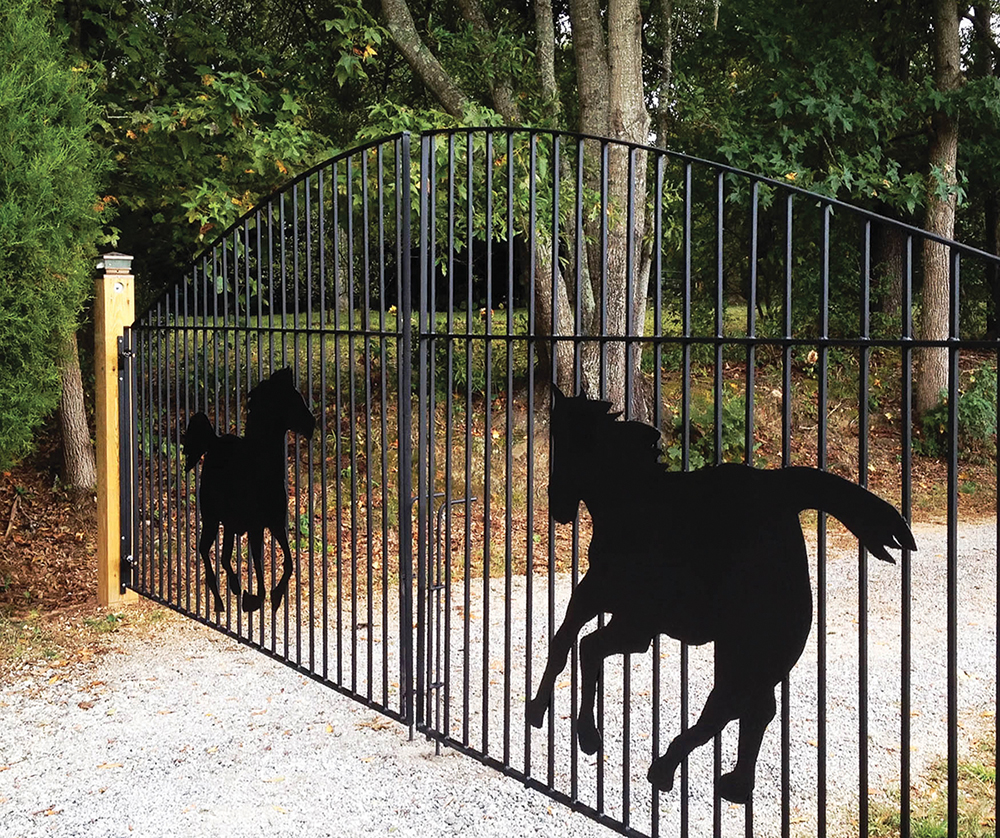
In addition to making accessories for Kathleen’s tile work and similar projects, Crowell delved into ornamental ironwork drawn from the Arts and Crafts stylebook. “I stayed there in Saluda for seven years, but then we found this site in Tryon and put up a purpose-built workshop,” Crowell says. This, he explains, allowed him to expand to the large, complex pieces for which he’s become noted. Over the years, these more ambitious projects have included a five-foot-tall steel tree with a 21-foot diameter — designed for a Columbia, South Carolina, restaurant — and a series of delicately wrought entry and garden gates, some with filigreed floral patterns, that welcome visitors to many of the Tryon area’s upscale residential developments and equestrian estates.
Despite his seventy years, Crowell still wields a hammer with aplomb in an activity few his age would undertake as easily. Even after four decades, the hot, physical work, says Crowell, “is too much fun to be hard.”
Saluda Forge, 73 Ola Mae Way, Tryon, 828-859-9278, saludaforge.net. The forge is open every day except Sunday from 9am-4pm.