Timber-frame architect understands the demands of the mountains
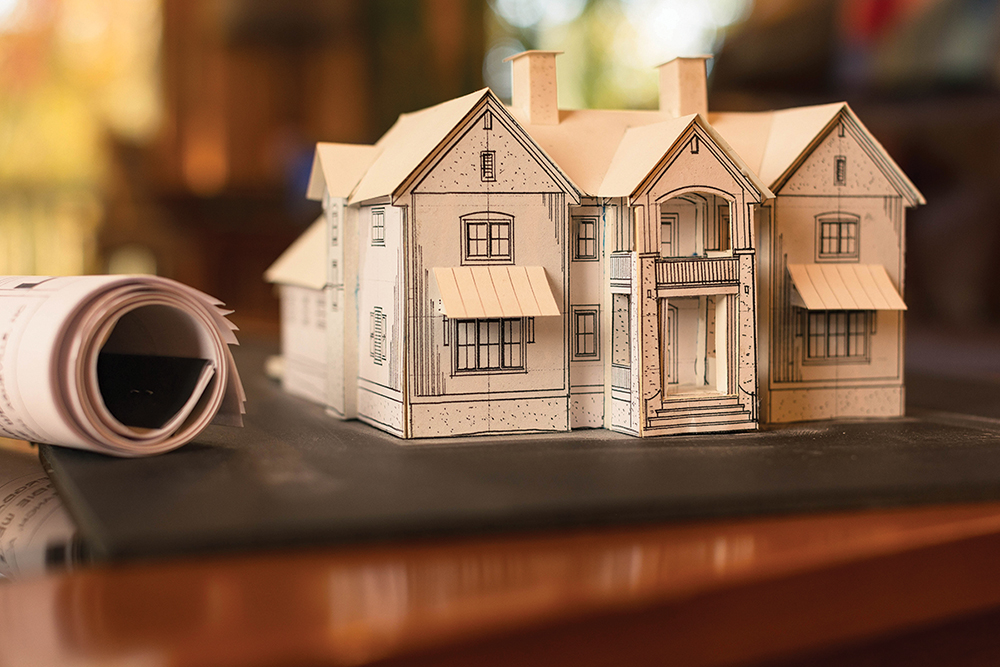
Photo by Colby Rabon
When Ken Wertheim was growing up in New York State, near the Canadian border, his European-born parents loved to spend family summers in rustic cabins in the northeastern mountains, hiking in woods scented with pine and cedar and marveling at the elaborate timber summer homes built by Gilded Age millionaires — the “Great Camps” that once lined the lakes of the Adirondacks.
Now, decades later, those memories infuse Wertheim’s Asheville-based practice, Mountain Architecture, opened in Western North Carolina in 1998. “I specialize in residential mountain architecture with an emphasis on timber framing and sustainable green design,” Wertheim says. “Many are hybrid systems incorporating both timber-frame and stick-built construction, with timber frame in the most important spaces such as the great room, kitchen, dining-room, and primary-bedroom suite,” he explains.

Architect Ken Wertheim combines classic post-and-beam construction with green amenities.
Photo by Colby Rabon
A fine example of Wertheim’s aesthetic is a current project planned as a roughly 3000-square-foot home in Black Mountain. It’s being designed as a summer retreat for clients with a primary residence on the North Carolina coast.
“They were interested in a mountain lodge with an Arts and Crafts/Mission style,” says the architect. “They wanted a home that was practical, informal, with spacious gathering areas that felt comfortable, with a warm and cozy feeling.” It was perfectly in step with Wertheim’s thick portfolio of custom mountain-resort homes, made even more suitable given his role as a regional independent representative for New Hampshire-based Timberpeg, one of the nation’s oldest and largest materials suppliers for traditional timber-frame construction.
“The clients became very interested in a Timberpeg home after seeing photos online of timber-frame projects and having visited several Timberpeg projects in our area,” Wertheim explains. “Because the structure is post and beam, lots of walls of glass to capture views were possible. It allowed for the extension of living spaces to the outdoors and brought nature into the house.” Visually established by the Douglas fir timber frame, the ceilings of white pine, terraces, decks, and covered porches further tie the house to its surroundings, along with a separate pavilion that will house a hot tub.
While Timberpeg projects are occasionally adapted from previously designed homes, most are custom-designed, as in the case of Wertheim’s clients, and often in collaboration with architects. Working from the architect’s plans and construction blueprints, the company provides a package that includes the authentic mortise-and-tenon pegged joinery, post-and-beam timber frame, structural insulated panels (or SIPs), siding, windows, roofing, and exterior doors. “We typically also include timber-framed porches, entry porticoes, and timber details and trusses,” adds Wertheim. “Timber-frame homes using SIPs are very energy efficient and provide building envelopes which are very tight.”
In other words, while a timber-frame home is part of a grand tradition, its modern incarnation can include many innovations. “Many of my clients also incorporate solar and alternative-energy features as part of the home design,” the architect notes.
Adding to this project’s complexity is the site’s challenging mountain geography. “The property is within Buncombe County’s Steep Slope ordinance overlay,” Wertheim points out, “and that carries specific requirements and guidelines.” Geotech engineering reports must be produced and approved, along with septic-system requirements tailored to steeply sloping landforms.

Even more critically, the site’s elevation called for structural engineering allowing the home to withstand wind loads of up to 140 miles per hour. “It’s very important when building a new home in the Asheville region to engage licensed professionals, because this area has very specific site and structural requirements, very different from other areas,” Wertheim says.
Before the design phase for the Black Mountain project began, Wertheim gave his clients the four-page questionnaire he uses for each new undertaking, providing him with an understanding of the homeowners’ expectations, specific needs, and budget. It’s a critical part of any new project Wertheim undertakes, forming the foundation for everything that follows.
So crucial for Wertheim is the entire design process that he’s written a book about it, Designing Your Custom Home, a step-by-step guide that will be published during the coming year. “Every design I start begins with a site evaluation and a site analysis first, which becomes the basis from which conceptual design takes form,” Wertheim says. “It’s important in the mountains to design with the land and not force a stock plan on it.
“As Frank Lloyd Wright believed, a house should be of the land, not on it.”
Kenneth J. Wertheim, architect, Asheville, 828-713-3370, mtnarc.com. See also timberpeg.com.
Excellent and very well said Ken, a house should feel melded in with the land not on top of it. I have always loved Kens designs and working with him for 30 years i have seen a lot of them. He is the most comfortable architect to work with i have come to know in my term, i remember working with him on a project the customer wanted a harmonious home environment to promote well-being and positive energy for “Feng Shui”, the customer was very happy with the outcome.