
Landscape designer reveals surprising elements of great gardens

Landscape designer Amy Fahmy is known for bold ideas such as placing color low on the list of important garden elements.
Photo by Colby Rabon
For the past 14 years, Asheville native Amy Fahmy has managed a wide range of fine garden-design commissions at Sitework Studios — a leading landscape-architecture firm in Asheville. A registered landscape contractor, she has designed for Richmond Hill Inn and Biltmore Estate and teaches a popular class, “Stealing from the Great Gardens,” where she reveals secrets gleaned from famous examples of horticultural artistry that folks can incorporate into their own residential gardens.
“First decide if you want it to be formal or informal,” she advises, “and stick to that.” But formal doesn’t necessarily mean neat and tidy, and informal doesn’t mean plantings are wild and all over the place.
It’s about the lines — either straight, geometric, and symmetrical or curved, sweeping, and asymmetrical. “You may have long, formal lines leading to a focal point,” Fahmy explains, “and then line that path with wildflowers and grasses, or have an informal structure, but the plantings are tidy and buttoned-up.
“Structure is the part people usually have a really hard time with because it’s not always easy to read — and nature has evolved that organizational aspect over millions of years.”
For gardeners to better grasp the concept, she recommends Elements of Garden Design, a book by Joe Eck of North Hill Garden in Vermont, as one of the best resources that shows behind-the-scenes techniques that make a garden come together.
“One idea is to give it enclosure with a perimeter of plantings so it becomes this special retreat and hidden sanctuary,” says Fahmy. “Maybe bring it back away from the street; the goal is to block out the view from the world. Then frame the view seen from inside the garden. For example, you might like a view of your neighbor’s Japanese maple. A carefully curated and framed view is something you see in all of the world’s great gardens.”
Fahmy also pays close attention to the way a person enters a garden, emphasizing how that transition is an opportunity to convey that something beautiful is coming. “It may be through a gate or under a vine-covered arbor, beneath an arching tree branch or enclosed with hedges or fencing. That sense of change creates a surprise element — you think, ‘Oh, wow, look at this! I didn’t know this was here.’ And you can do it even in a tiny garden, where you turn a corner and suddenly there’s some magical space you didn’t expect.”
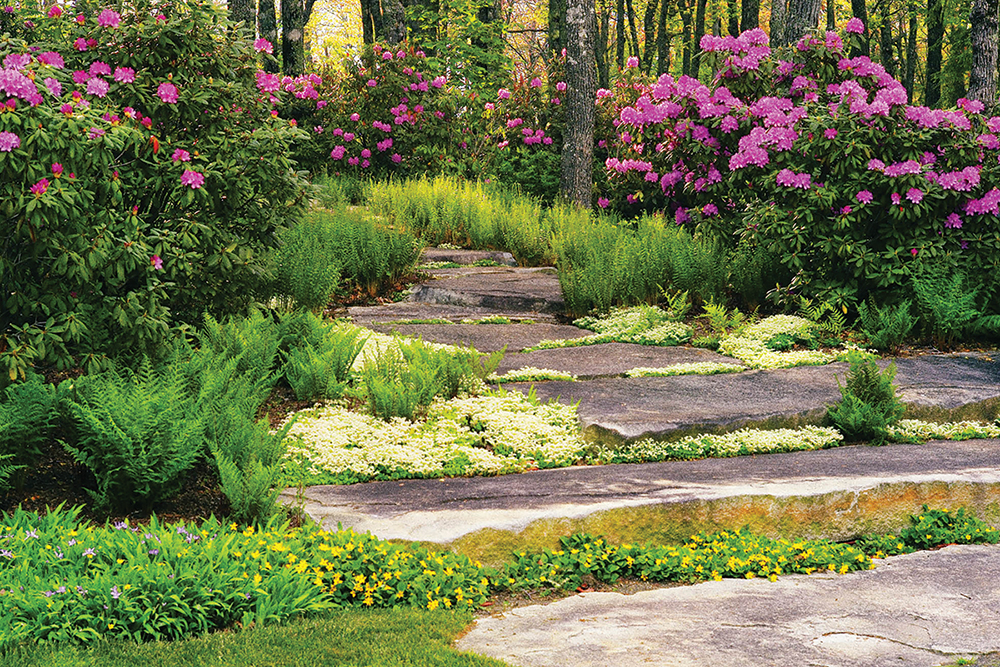
Photo by Colby Rabon
Fahmy describes how multiple “garden rooms” can be incorporated — each like a gallery, with its own sense of expectation and exciting reveal.
“Another tip is progressive realization, which means as you go through a garden you realize more details enticing you forward. You may hear the sound of water but can’t see it, or see glimpses of sculpture or a boulder as you move through the garden until it’s fully revealed.”
Interestingly, when it comes to a successful planting composition, Fahmy places color low on the list. “The most important elements are form and texture, like plants with fine leaves next to large-leafed ones,” she says. “Keep it simple. Consider a more limited palette of no more than three colors, but with different shades and intensities of [those colors].”
Amy Fahmy will present “Stealing from the Great Gardens” Saturday, May 24, 10am-noon, at Asheville Botanical Garden (151 WT Weaver Blvd. at UNCA Asheville). For more information, see ashevillebotanicalgarden.org.